

Monthly Learnings: El Cafecito
El Cafecito 2023:“Filling up our coffee cups”
After surveying attendees of the El Cafecito subgroup we learned about a common need for deeper conversations on wellbeing and mental health in the Spanish speaking community. As a response to the identified need, El Cafecito 2023 will focus on the stories and experiences of bilingual mentors/coaches. The theme of our February session was “Filling up our coffee cups” parting from the concept of “you can’t pour from an empty cup”. Our session started with members sharing personal definitions of wellbeing and self-care. Followed by a moment of reflection on the nature of the work we do as mentors of individuals who are facing multiple challenges while they navigate a different culture and language. We took some time to acknowledge that mentors also have Executive Functioning skills that can go “offline” when stress is present.
Next, we explored the bilingual mentor challenge. As we conversed over the slide below one of the attendees gasped and took a photo of the screen. We invited the attendee to share what inspired that reaction. The attendee thanked El Cafecito moderators for acknowledging the often-overlooked challenges for bilingual mentors.
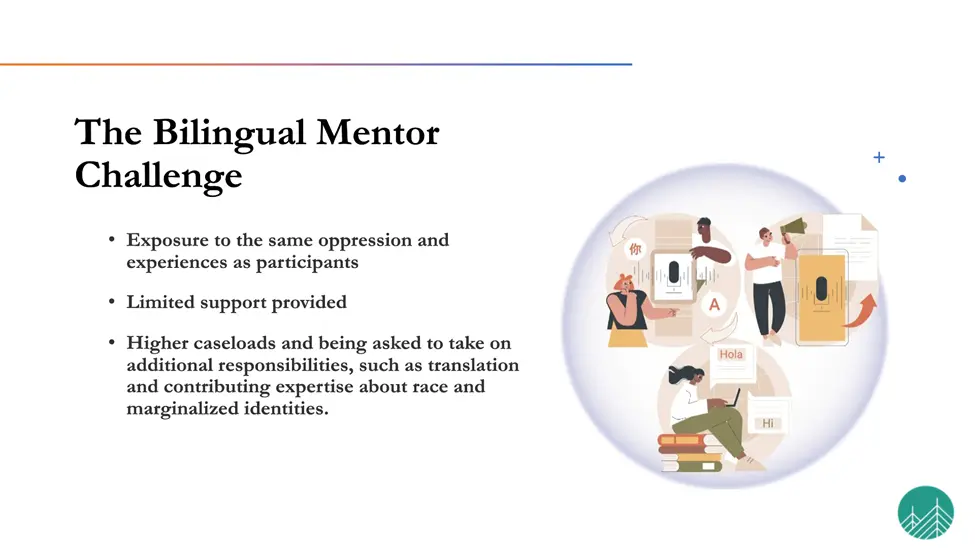
The bilingual mentor challenges
While conducting research to guide the conversations for El Cafecito 2023 sessions we learned the issues identified as the bilingual mentor challenge are extremely common. The National Child Traumatic Stress Network (a project funded in 2000 by the US Department of Health and Human Services’ Substance Abuse and Mental Health Services Administration) identifies the challenges of the bilingual mentor as predicting indicators for secondary traumatic stress or vicarious trauma.
The NCTSN states that providers/mentors of color may experience elevated levels of Secondary Traumatic Stress and/or moral distress when working with individuals who hold marginalized identities, who do not have equal access to culturally appropriate resources, and/or who are overrepresented in systems they serve. This can be especially challenging for providers/mentors who hold similar marginalized identities to the participants they serve. In addition, these mentors often experience exposure to the same oppression and racism as participants. Mentors/Providers are likely to have their own experiences of discrimination and microaggressions and may also be experiencing and observing institutional racism and oppression in the agencies, systems, and/or communities in which they work. In all of these situations, mentors may be experiencing primary trauma as well as secondary trauma.
The NCTSN indicates that providers/mentors of color and/or those who hold marginalized identities may experience lack of safety or support in their agency, especially if they do not have colleagues who share their identities or experiences. Leadership, supervisors, and colleagues may avoid talking about culture, race, and historical trauma and may minimize the importance of these issues. This avoidance and minimization can also contribute to a workplace feeling unsafe. It is hard to help participants feel safe when you as a provider/mentor do not feel safe.
Providers of color (especially multilingual providers) often have higher caseloads and informal additional job responsibilities compared to their white counterparts. For example, multilingual providers are often called on to translate for colleagues or translate written materials in addition to their regular workload. They may also be asked to contribute expertise about cultural, racial, or other identities in addition to expertise related to their role. Providers of color may also feel a sense of responsibility to educate others on racism and the impact of cultural or historical trauma, especially if they witness or experience bias among colleagues. All of these added requests and responsibilities can add to providers feeling overwhelmed and more vulnerable to secondary trauma.[1]
Finding Balance
We closed our first Cafecito 2023 session with some suggestions from the NCTSN. The main suggestion is to identify ways to find balance in the mist of the challenges encountered by bilingual mentors. The NCTSN also suggest to practice gratitude about the positive aspects of the work, listing inspiring and rewarding stories from participants and constantly recognizing that “the work” makes a meaningful contribution to participants and society.
The next Cafecito sessions will cover additional suggestions to manage stress from the NCTSN including tools to find balance.
[1] Cuellar, R., Hendricks, A., Clarke, M., Sprang, G., & the NCTSN Secondary Traumatic Stress Collaborative Group. (2022). Secondary Traumatic Stress: Understanding the Impact on Professionals in Trauma-Exposed Workplaces. Los Angeles, CA, and Durham, NC: National Center for Child Traumatic Stress.
Copyright © 2022 National Center for Child Traumatic Stress on behalf of Raven Cuellar, PhD; Alison Hendricks, MSW, LCSW; Megan Clarke, MPH; Ginny Sprang, PhD; and the National Child Traumatic Stress Network. This work was funded by the Substance Abuse and Mental Health Services Administration (SAMHSA), US Department of Health and Human Services (HHS), which retains for itself and others acting on its behalf a nonexclusive, irrevocable worldwide license to reproduce, prepare derivative works, and distribute this work by or on behalf of the Government. All other rights are reserved by the copyright holder(s).